CORS#
Vapor by default provides a middleware for implementing proper support for Cross-Origin Resource Sharing (CORS) named CORSMiddleware.
“Cross-Origin Resource Sharing (CORS) is a specification that enables truly open access across domain-boundaries. If you serve public content, please consider using CORS to open it up for universal JavaScript / browser access.” - http://enable-cors.org/
To learn more about middlewares, please visit the Middleware section of the documentation here.
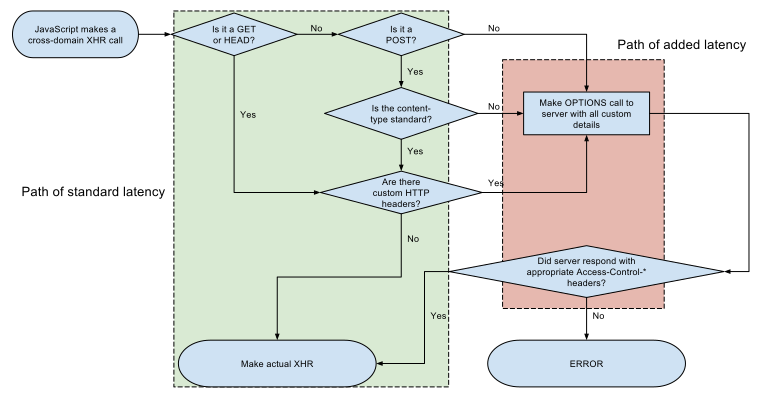 Image Author: Wikipedia

Basic#
First of all, add the CORS middleware into your droplet middlewares array.
# Insert CORS before any other middlewares
drop.middleware.insert(CORSMiddleware(), at: 0)
Note: Make sure you insert CORS middleware before any other throwing middlewares, like the AbortMiddleware or similar. Otherwise the proper headers might not be added to the response.
CORSMiddleware has a default configuration which should suit most users, with values as follows:
Allowed Origin
Value of origin header in the request.
Allowed Methods
GET,POST,PUT,OPTIONS,DELETE,PATCH
Allowed Headers
Accept,Authorization,Content-Type,Origin,X-Requested-With
Advanced#
All settings and presets can be customized by advanced users. There’s two ways of doing this, either you programatically create and configure a CORSConfiguration object or you can put your configuration into a Vapor’s JSON config file.
See below for how to set up both and what are the options.
Configuration#
The CORSConfiguration struct is used to configure the CORSMiddleware. You can instanitate one like this:
let configuration = CORSConfiguration(allowedOrigin: .custom("https://vapor.codes"),
						                  allowedMethods: [.get, .post, .options],
						                  allowedHeaders: ["Accept", "Authorization"],
						                  allowCredentials: false,
						                  cacheExpiration: 600,
						                  exposedHeaders: ["Cache-Control", "Content-Language"])
After creating a configuration you can add the CORS middleware.
drop.middleware.insert(CORSMiddleware(configuration: configuration), at: 0)
Note: Please consult the documentation in the source code of the
CORSConfigurationfor more information about available values for the settings.
JSON Config#
Optionally, CORSMiddleware can be configured using the Vapor’s Config which is created out of the json files contained in your Config folder. You will need to create a file called cors.json or CORS.json in your Config folder in your project and add the required keys.
Example of how such a file could look as follows:
{
    "allowedOrigin": "origin",
    "allowedMethods": "GET,POST,PUT,OPTIONS,DELETE,PATCH",
    "allowedHeaders": ["Accept", "Authorization", "Content-Type", "Origin", "X-Requested-With"]
}
Note: Following keys are required:
allowedOrigin,allowedMethods,allowedHeaders. If they are not present an error will be thrown while instantiating the middleware.Optionally you can also specify the keys
allowCredentials(Bool),cacheExpiration(Int) andexposedHeaders([String]).
Afterwards you can add the middleware using the a throwing overload of the initialiser that accepts Vapor’s Config.
let drop = Droplet()

do {
	drop.middleware.insert(try CORSMiddleware(configuration: drop.config), at: 0)
} catch {
	fatalError("Error creating CORSMiddleware, please check that you've setup cors.json correctly.")
}